The Recency Trap
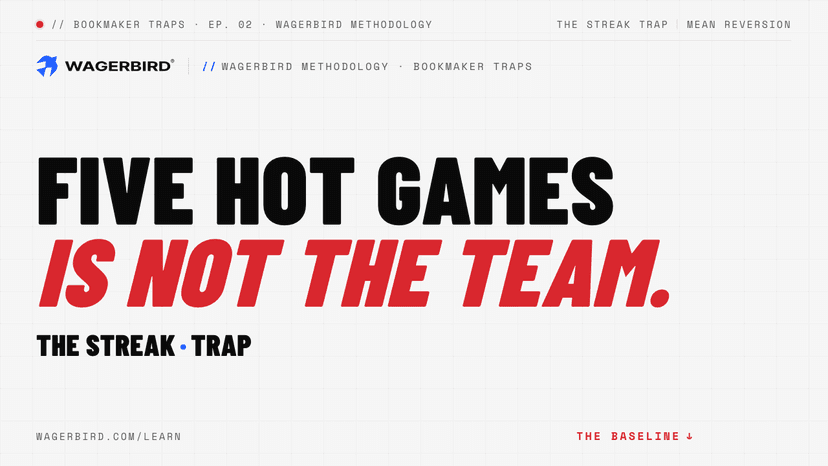
A 30 percent career hitter goes 4 for 5 in his last 5 games and the bettor's eye anchors on 80 percent, but the formal Bayesian posterior moves the true rate from 30.0 percent to 30.2 percent because a 5-game sample is statistical noise against a 1,200 at-bat prior. The book knows this and prices the prop at the public's anchored line of plus 110, implied 47.6 percent, while the true fair line is plus 220, implied 31.25 percent, leaving the bettor paying roughly 36 percent expected-value rent. The discipline is to bet the prior, not the streak.
Episode 14 of the WagerBird Methodology series. Watch on YouTube
What Is Recency Bias
Recency bias is a specific form of the availability heuristic (Tversky and Kahneman 1973). The most recent and most vivid observations dominate the probability estimate. The bettor's intuitive update from a 5-game streak weights the streak roughly as if it were the whole sample. The formal Bayesian posterior weights it correctly: 5 samples against a 1,200-sample prior moves the true rate by fractions of a percentage point.
The Worked Example
Player prop, '2+ hits in a game.' Career rate: 30% on 1,200 ABs. Recent streak: 4 hits in 5 games. Bettor's intuitive posterior: 60-80%. Bayesian posterior: 30.21%. The 5-game streak moved the true rate by 0.21 percentage points. The book posts the line at +110 (implied 47.6%), shaded toward the public's anchor. The fair Bayesian line is +220 (implied 31.25%). The gap: 17 percentage points of perception. The EV at posted: -36.6%, roughly 7.8x the pregame standard hold of 4.7%.
The Asymmetry
The bettor and the book see the same 5-game streak. The bettor uses it to form a probability estimate. The book uses it to predict where the public will overbet. The line lives at the price that maximizes the book's take given the predictable public skew, not at the price that reflects the true probability.
How WagerBird Prices It
WagerBird picks are generated from a model that builds the full Bayesian prior from career samples. Recent performance is one input among many, weighted by sample size. A 5-game streak gets the weight of 5 samples. A 1,200-AB career gets the weight of 1,200 samples. The math does the weighting automatically.
The Transcript
Machine transcript of the narration, lightly cleaned. It reads as spoken word rather than authored prose.
Recent is loud. Career is right. The streak the bettor sees, the prior the better skips. This is the recency trap.
Here's what the better says about a hot streak. He's locked in. He has four hits in his last five games. He has to be a 60% prop hitter right now.
Here is what the streak actually is, statistical noise against a long career sample. Five at bats moves a 1200 at bat prior by fractions of a percentage point. The recency bias overweights what just happened. The Bayesian math underweights small samples relative to large priors.
The book prices the line at the public's anchored perception. The bettor pays the gap. Run the math on a representative prop. The player has a 30% career rate on two plus hits in a game over 1200 at bats across multiple seasons.
The Bayesian prior is a beta distribution with 360 hits over 1200 at bats. The recent observation is four hits in five games, 80% recent rate. The bettor's intuitive update is somewhere between 60% and 80%. The Bayesian posterior is the formal correction.
364 hits over 1205 at bats. 364 / 1205 30.21%. The five game streak moved the true rate by 0.21 percentage points. The streak is real.
The streak does not change the probability. Now, the line. The book posts the prop at +110. Implied probability 47.6%.
The fair Bayesian line is +220. Implied probability 31.25%. The gap is 17 percentage points. The expected value at the posted line per 100 staked.
0.3021 * 110 = $33.23. Less 0.6979 * $100 = $69.79. Net - $36.56 per 100 staked. -36.6% expected value.
7.8 times the pre-game standard hold. The better paid the recency tax. This is the asymmetry the recency trap depends on. The better and the book both see the same five-game streak.
The better uses the streak to form a probability estimate. The book uses the streak to predict where the public will overbet. The bettor's eye anchors on the recent four of five. The book's pricing model anchors on the career 30%.
Both have the same information. They use it for opposite purposes. The better estimates probability. The book estimates public action.
The line lives at the price that maximizes the book's take given the predictable public skew, not at the price that reflects the true probability. This is where WagerBIRD lives. Each WagerBIRD pick is generated from a model that builds the full Bayesian prior from career samples. Recent performance is one input among many weighted by sample size.
A five-game streak gets the weight of five samples. A 1,200 at bat career gets the weight of 1,200 samples. The math does the weighting automatically. The model does not flinch when the streak gets loud.
The signal sets the stake. The streak does not change the signal. This is the pattern. The bettor sees a hot streak and forms a wrong probability estimate from a tiny sample.
The book sees the same streak and shades the line toward the public's anchor. The gap between the anchor and the prior is the recency tax. The trade is to bet the prior, not the streak. The rule is It's sentence.
Recent is biased, the career is the prior, bet the prior. Every WagerBIRD pick is published with the confidence score alongside the pick. The Terminal carries the full pre-game board including every gem.
We bet the prior, see it, size it, send it. What does that mean? See it. The pick lives in the Terminal on the full 25-100 confidence scale.
Size it. Higher confidence, larger position. Send it. Take the pick out of WagerBIRD.
Your bet is placed at your book, wherever you place your action. WagerBIRD is the analytics platform that prices the market itself. No handicappers, no personalities, real traders, real models, real edge. As we say here at WagerBIRD, a see it, size it, send it.
MORE BOOKMAKER TRAPS