The Boost Trap
The odds boost on a single leg is genuinely positive expected value most of the time, which is exactly what makes it a believable lure for the multi-leg ticket the book actually wants you to build. On a 22 percent boost on a typical player prop the leg EV swings from minus eight percent to plus five percent, real positive value, but the standard 3-leg parlay structure that retail bettors typically build around the boosted leg compounds the hold on the unboosted legs and restores roughly minus four percent EV on the ticket. The discipline is to bet the line you would have bet anyway, not the line the book put a sticker on.
Episode 13 of the WagerBird Methodology series. Watch on YouTube
What Is A Boost
An odds boost (also branded as 'profit boost', 'price boost', 'enhanced odds', or 'special offer') is a promotional price improvement the book offers on a specific selection, typically capped at $10-$100 max stake. The boost magnitude is usually +15 cents to +50 cents of American odds, advertised in the UI as a payout uplift ('+22% more payout'). Boosts cluster on player props, longshots, and SGP-eligible markets where the underlying hold is structurally wider than the 4.7% pregame moneyline standard.
The Worked Example
Player prop, 'Hot hitter 2+ hits.' Underlying market hold: 8% (typical for player props). Posted price: +180. True book probability: 32.9%. EV at posted: -$8.00 per $100 = -8% (matches standard hold). Boost: +220, advertised as '+22% more payout.' EV at boosted: +$5.15 per $100 = +5.15%. The boost is genuinely positive expected value on a standalone basis. The leg EV swing: +$13.14 per $100 staked.
The Parlay Trap
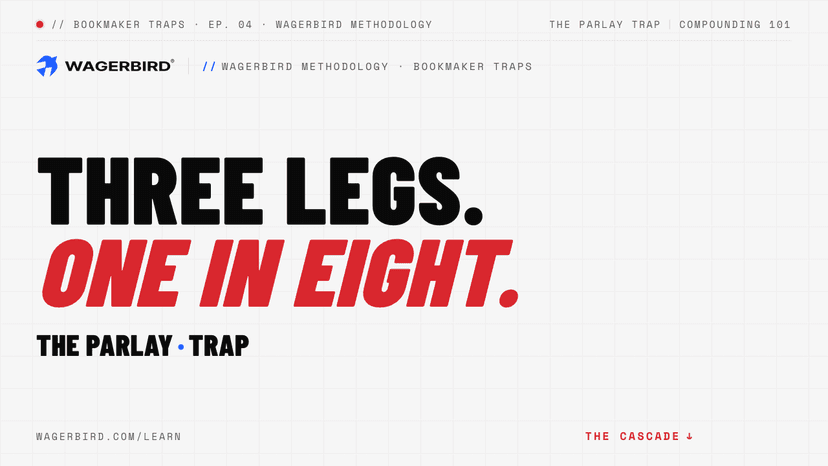
The boosted leg is positioned in the UI next to 'Add to parlay.' Typical retail behavior is to build a 3-leg ticket around the boosted leg. Legs 2 and 3 at standard -110 juice (4.5% hold each). Compound probability of all hitting: 8.21%. Parlay payout: +1066. EV of 3-leg parlay: -$4.27 per $100 = -4.3%. The +$13 of leg EV becomes -$4 of ticket EV because compound hold across the unboosted legs eats the boost gain and adds more.
The Cap
Max bet on a boost is typically $25. Even at +5% standalone EV, the maximum expected profit per boost play is $1.29. Boost-extractors who systematically play boosts at the cap get account-limited within 10-20 plays. The +EV opportunity exists, is real, and is not sustainable at scale.
How WagerBird Prices It
Every WagerBird pick carries its signal strength. There is no stacking around a promotion. Signal sets the size. The presence of a boost is treated as a contrarian flag: a boost says the book wants you in this market right now. The model ignores the sticker and prices the line independently.
The Transcript
Machine transcript of the narration, lightly cleaned. It reads as spoken word rather than authored prose.
Boost on the leg, hold on the ticket, the price that moved, the trap that surrounds it. This is the boost trap. Here is what the better says about boosts. Free 40 cents of value, 22% more payout.
The book is giving something away. Here is what the boost actually is. A rooting product. The book selects a market where the standard hold is wider than the pre-game baseline.
The book moves the displayed price closer to fair value. The boost on the leg is real. The boost is also bait. The book serves the boosted leg next to add to parlay.
The better builds a three-leg ticket around the bait. The compound hold across the unboosted legs eats the boost gain and adds more rent on top. Run the math on a representative ticket. The player prop hot hitter, two plus hits.
The underlying market hold is 8% wider than the pre-game moneyline standard of 4.7%. The posted price is +180. The implied probability at posted is 35.7%. The book's true model probability is 32.9%.
The expected value at the posted line, 0.3286 * 180 = $59.15. Less 0.6714 * $100 = $67.14. Net minus $7.99 per 100 staked. Minus 8% expected value.
The standard hold on this market. Now the boost, +220, advertised as 22% more payout. The expected value at the boosted price, 0.3286 * 220 = $72.29. Less $67.14.
Net plus $5.15 per 100 staked. Plus 5% expected value. The boost is real. The boost is positive.
The boost gave the better a $13 swing on the leg. Now the trap. The boosted leg is positioned in the user interface next to add this leg to your parlay. The better builds a three-leg ticket.
Leg one is the boost. Legs two and three are standard pre-game side bets at -110. Each unboosted leg carries the standard 4 and 1/2% hold. The compound probability of all three legs hitting is 8.21%.
The compound payout in American odds is +1,066. The expected value of the three-leg ticket, 0.0821 * 1,066 = $87.52. Less 0.9179 * $100 = $91.79. Net minus $4.27 per hundred staked, -4% expected value.
The boost gave $13 of leg expected value. The parlay structure took back $17 of expected value. Net minus $4 per ticket. This is the asymmetry the boost product depends on.
The bettor sees one number, the boost on the leg, and one outcome, the ticket's settled. The book sees the entire session. The better selected to play a market they would not have played at the posted price. The better built a three-leg ticket around the bait.
The better placed the parlay at a stake well above the $25 boost cap. The bettor's eye anchored on 22% more payout. The book's spreadsheet anchored on three legs of compound hold. Each dollar of boost expected value given to the better returns roughly $3 of standard juice rent across the session.
This is where Wagerbird lives. Each Wagerbird pick is published with a confidence score from 25 to 100. There is no stacking around a promotion. The signal sets the size.
The signal does not change because the book put a sticker on the price. The presence of a boost is a contrarian flag. A boost says the book wants you in this market right now. WagerBird reads that signal and ignores the sticker.
The position lives on the line WagerBird's model says is correct size to the bankroll and to the signal with no behavioral lift from the boost. This is the pattern. The boost is the visible lift on the leg the book wants you to play. The ticket is the structure the book built to absorb the boost gain and take back more.
The bettor sees the lift on the leg. The book books the rent on the ticket. The trade is to bet the line WagerBird's model produced regardless of whether the book has put a sticker on the price. The rule is one sentence.
Boost is the bait, the ticket is the trap, bet the line you would have bet. Every WagerBird pick is published with the confidence score alongside the pick. The Terminal carries the full pre-game board including every gem.
We bet the line the model produced. See it, size it, send it. What does that mean? See it.
The pick lives in the Terminal on the full 25 to 100 confidence scale. Size it. Higher confidence, larger position. Send it.
Take the pick out of WagerBird. Your bet is placed at your book wherever you place your action. WagerBird is the analytics platform that prices the market itself. No handicappers, no personalities, real traders, real models, real edge.
As we say here at WagerBird, a see it, size it, send it.
MORE BOOKMAKER TRAPS