- The best NFL betting strategy focuses on probability vs. sportsbook pricing, not predicting game outcomes.
- NFL betting markets are highly efficient, which means edges tend to be small but repeatable.
- Long-term performance is best evaluated through expected value and closing line value, not short-term win rate.
- Data-driven models and confidence-weighted bet sizing help bettors identify and act on market inefficiencies.
The Best NFL Betting Strategy: Finding an Edge in NFL Betting Markets
The NFL is the most bet sports league in the United States, and it is not particularly close. DraftKings sportsbook director Johnny Avello described the league’s betting handle in 2025 as “off-the-charts great.” Billions of dollars move through NFL markets every season, from Week 1 through the Super Bowl, and that volume attracts some of the sharpest bettors and most sophisticated pricing models in the world.
All this makes the NFL one of the most efficient sports betting markets. For bettors, that means large edges are hard to find and even harder to sustain. The bettors who do well long term are working with a structured process, not just a strong opinion on Sunday’s game.
In this guide, we’ll break down the core principles behind a winning NFL betting strategy, covering everything from probability modeling and line shopping to bankroll management and closing line value, so you can build a process that finds real edge in NFL markets.
Point Spreads vs. Moneylines: Choosing the Right Market
Two of the most common NFL betting markets are point spreads and moneylines, and knowing when to use each one is a core part of any solid NFL betting strategy.
The moneyline is straightforward. You’re betting on who wins the game outright. The point spread levels the playing field by adding a margin of victory requirement. A -6.5 favorite needs to win by seven or more for a spread bet to cash. A +6.5 underdog can lose by six and still cover.
When the Moneyline Makes More Sense
Moneylines tend to offer more value in games where the spread is small. When a team is favored by two or three points, the moneyline price is often close enough to the spread that the extra flexibility of betting the outright winner is worth considering. Underdogs on the moneyline can also offer compelling value when the public is inflating a favorite’s price. You’re getting paid more simply because the market is overreacting to reputation or recent form.
When the Spread Is the Better Play
Point spreads shine in games with larger favorites. Laying -350 on the moneyline for a team you like is a tough number to work with long term. The spread brings that price back down to a more manageable level, typically around -110, which makes it easier to find positive expected value. Spreads are also where key numbers become especially important. Landing on the right side of 3 or 7 can make a real difference in results over a full season.
Reading Both Markets Together
The sharpest bettors don’t just pick a market and stick to it. They look at both the spread and the moneyline for every game and evaluate where the better number lives. Sometimes the moneyline on an underdog offers more value than the spread. Sometimes the spread on a favorite is the cleaner play. Comparing the two gives you a more complete picture of where the market is and where the opportunity might be.
Why NFL Betting Markets Are So Efficient
Beating the NFL market is genuinely difficult in part because the market is so efficient. No other sport attracts the same combination of betting volume, sharp participation, and sophisticated bookmaking. If you are coming in with a gut feeling and a box score, the market has already moved past you.
Sharp bettors are active in NFL markets all week long. Sportsbooks use pricing models that update in real time. Injury news, weather forecasts, and line movement all get absorbed into the price faster than most bettors can react. By the time a casual bettor places a wager on Sunday morning, the market has already processed an enormous amount of information.
The result is that large pricing errors are rare. Most edges in NFL betting are small and repeatable rather than obvious and exploitable. Bettors who succeed in this environment rely on disciplined processes, analytical tools, and large sample sizes to let those small edges add up. Short-term win streaks tell you very little about whether your process is actually working.
Bankroll Management and Confidence-Weighted Bet Sizing
The good news is that a structured approach to bankroll management is one of the most accessible edges available to any bettor, regardless of experience level. You do not need a proprietary model or a team of analysts to manage your money well. You just need a framework and the discipline to stick to it.
That said, even a well-constructed NFL betting strategy runs into variance. A bettor hitting 55% of their wagers can still drop eight to ten bets in a row. Knowing that going in makes it much easier to stay the course when a losing streak hits.
WagerBird’s Terminal tracks your edge and confidence scores so your sizing decisions are grounded in data, not instinct. See how it works.
Why Traditional Unit Systems Fall Short
Most NFL betting guides recommend flat unit-based wagering, typically sizing each bet at one to two percent of your bankroll. It’s a reasonable starting point, and it keeps losing runs from doing serious damage. The limitation is that it treats every bet as roughly equivalent, regardless of how strong the underlying edge actually is.
Two bets, both labeled “1 unit,” may have very different probability advantages behind them. A unit system doesn’t measure signal quality, which means it can obscure the relationship between bet sizing and edge strength.
Confidence-Weighted Bet Sizing
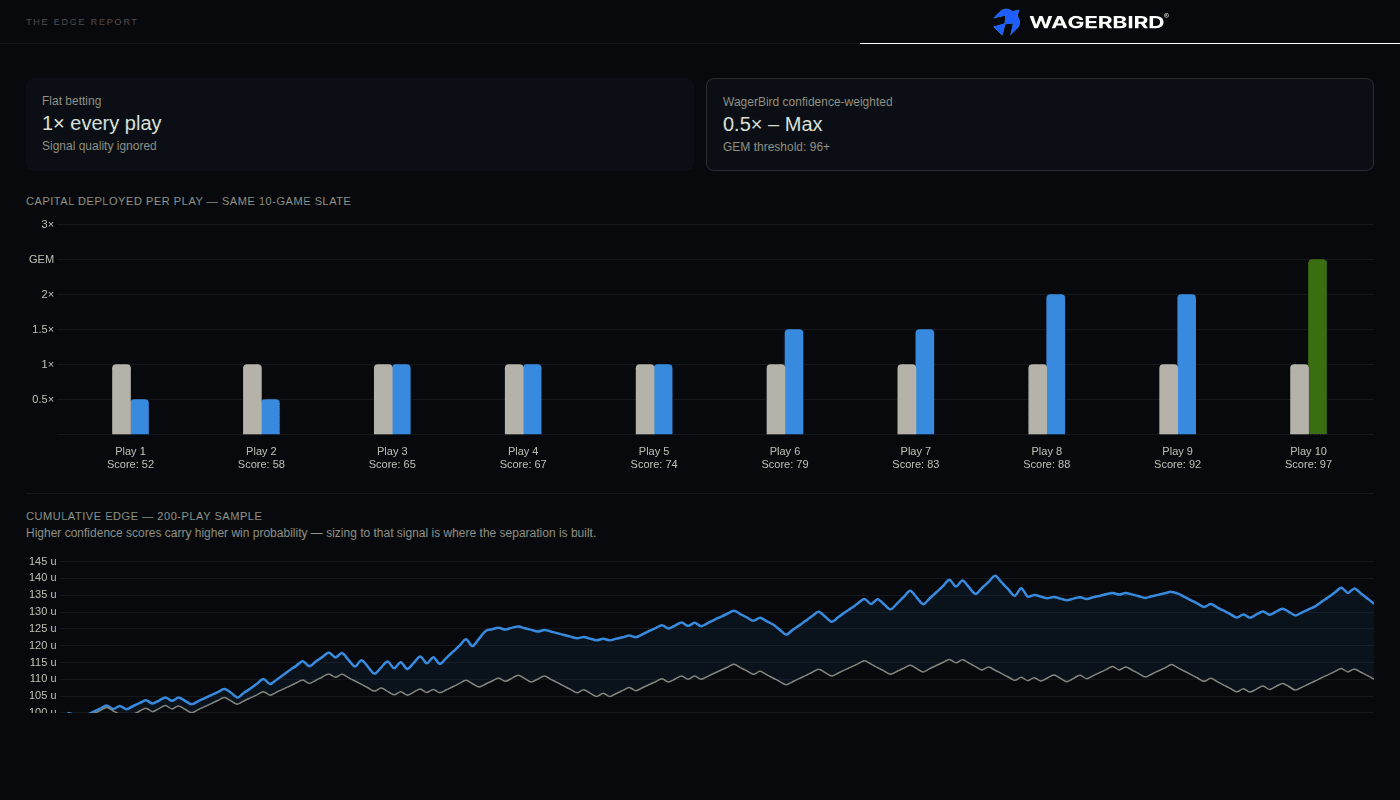
More advanced frameworks scale exposure directly to the estimated size of the edge. Rather than assigning every wager an arbitrary unit label, serious bettors tie position size to a calibrated confidence score, a numerical measure that reflects both model output and market context.
At WagerBird, every signal carries a confidence score on a 10 to 100 scale. That score isn’t a gut feeling dressed up in numbers. It reflects the size of the modeled edge, what the book’s pricing behavior is communicating, and how those two signals align. The higher the score, the larger the proportional allocation within your defined risk envelope.
The practical result: a play graded at 80 receives a materially larger allocation than one graded at 58. A play graded at 96 or above is what WagerBird designates a GEM, reserved for the highest-conviction signals, and receives maximum allocation. Plays below a threshold don’t get sized down. They don’t get placed at all.
This is the structural difference between confidence-weighted sizing and a unit system. Units create three or four buckets and call it a framework. Proportional confidence sizing means every bet is sized individually, with capital deployment tied directly to signal quality rather than a label someone assigned before the line moved.
Over a full NFL season, that precision compounds. The plays that deserved more got more. The plays that deserved less got less. And the marginal spots that shouldn’t have been played weren’t.
Line Shopping and Market Pricing Inefficiencies
Different sportsbooks regularly offer different prices on the same game. That might sound like a minor detail, but in NFL betting it matters more than almost any other sport. NFL scoring clusters around key numbers, and the most important ones are 3, 7, and 10. Getting -2.5 instead of -3, or +3.5 instead of +3, can be the difference between a push and a loss on a significant number of games across a season.
Here’s a simple example. Book A has a team at -3 (-110). Book B has the same team at -2.5 (-110). Same price, half a point of difference. In a market where final margins regularly land on 3, that half point has real expected value attached to it.
Sportsbook
Spread
Book A
-3 (-110)
Book B
-2.5 (-110)
Line shopping is one of the most straightforward improvements any bettor can make to their NFL betting strategy. It doesn’t require a model or any advanced analysis. It just requires having accounts at multiple books and taking an extra minute to find the best number before placing your bet.
Closing Line Value: The Sharp Bettor Benchmark
Closing Line Value measures how the price you bet compares to where the line closed before kickoff. If you bet the Chiefs at -2.5 and the line closes at -3.5, you’ve captured a full point of closing line value. The market moved past your number. Sharp money came in after you and pushed the line further, confirming you identified the value before the broader market caught up. Consistently beating the closing line is one of the clearest signals that your process is working. WagerBird’s Terminal helps you track it.
Why CLV Matters
By kickoff, the closing line has absorbed sharp bettor activity, injury updates, weather changes, and public betting pressure. It’s the most information-rich price available in the market. Getting a better number than that consistently means you’re identifying value before the market catches up.
CLV is a process metric, not a results metric. A bettor can lose a stretch of bets and still be beating the closing line, which tells you the process is sound and variance is just doing what variance does. Most professional bettors consider it the most reliable indicator that an NFL betting strategy is finding a real edge.
Using Data and Models to Find NFL Betting Edge
The sharpest bettors in NFL markets rely on quantitative analysis rather than intuition. Traditional stats like total yards and win-loss record don’t give you much of an edge because everyone already has access to them and they’re already priced in. Advanced metrics go deeper.
Advanced NFL Metrics Worth Knowing
Three metrics show up consistently in serious NFL analysis:
EPA per play measures offensive efficiency on a play-by-play basis and is one of the better predictors of future performance. Success rate tracks consistency, measuring how often a team achieves a successful play rather than just total yardage. DVOA evaluates team efficiency relative to league averages, adjusting for opponent strength and game situation.
These metrics give you a cleaner picture of what a team is actually doing than the scoreboard alone.
Building a Probability Model
Betting models estimate the true probability of game outcomes by combining multiple inputs. Injuries, pace of play, weather, rest days, travel distance, matchup dynamics, and historical performance data all factor in. Once the model produces a probability estimate, you compare it to the sportsbook’s implied probability and look for gaps.
When your model says 57% and the book is implying 52%, you’ve found a potential positive expected value opportunity. That gap is the edge. The entire discipline of data-driven NFL betting is about finding those gaps before the market closes them.
The catch is that the probability estimate is only as good as the inputs behind it. A bettor who eyeballs the injury report and calls it a model isn’t doing probability analysis. They’re doing intuition with extra steps. The gap between a real calibrated estimate and a gut feeling dressed up in numbers is where most bettors lose money they think they’re managing carefully.
Betting Intelligence Platforms
Building and maintaining a model is a significant undertaking, and most bettors understandably don’t want to do it from scratch. Modern betting intelligence platforms automate large portions of the analysis. The better ones provide model-derived signals, real-time odds monitoring, closing line value tracking, and signal filtering by confidence level.
The WagerBird Terminal is built around exactly this framework. The platform’s confidence scoring system handles the probability estimation problem directly. Every signal is calibrated against both model output and book pricing behavior, so you’re not just comparing your guess to the sportsbook’s number. You’re comparing a scored, market-informed edge to their implied probability. That’s a materially different starting point than anything a manually-built spreadsheet model produces.
5 Steps to Build a Repeatable NFL Betting Strategy
The best NFL betting strategy is a workflow, not a system of hunches. Successful bettors apply a consistent framework across every game they evaluate and track the results honestly enough to know whether it’s actually working. Here’s what that process looks like in practice.
1. Define a Dedicated Bankroll
Before you place a single bet, set aside a bankroll that’s separate from your everyday finances. This is the capital you’re working with for the season, and it’s the foundation everything else is built on. Knowing exactly what you’re working with makes every sizing decision cleaner and keeps a losing stretch from becoming a real problem.
2. Track Every Wager
Every bet is a data point. Track the odds you got, your stake, the result, your closing line value, and when you placed the bet relative to the closing line. Over time, that data tells you things your memory never will. Which bet types are performing, which markets you’re finding edge in, and whether your process is actually working or just running hot.
3. Compare Your Probability to the Sportsbook’s
This is the step that separates disciplined bettors from everyone else, and the one most people execute poorly. Before placing any bet, you need a calibrated probability estimate for the outcome, not a feeling about which team looks better this week. Compare that estimate to what the sportsbook is implying with their line. If your number is meaningfully higher, you have a potential positive expected value opportunity. If it isn’t, you move on. No exceptions.
The word “meaningfully” matters here. A half-point gap between your estimate and the book’s implied probability isn’t an edge. It’s noise. Real edge has room in it. If you can’t articulate why your number is different from the market’s number, what information or analytical approach produces a different estimate, the gap probably isn’t real.
4. Shop Lines Across Multiple Books
Never settle for the first number you see. Different sportsbooks regularly offer different prices on the same game, and in a market built around key numbers like 3, 7, and 10 in NFL, even half a point can swing expected value significantly. Having accounts at multiple sportsbooks and taking the extra minute to find the best available price is one of the simplest and most effective habits any bettor can build. It requires no model, no edge estimation, no analytical framework. It just requires the discipline to look.
5. Measure Performance Through Closing Line Value
Win rate feels like the obvious benchmark. It isn’t, not in the short run. A bettor hitting 55% across a 30-game sample might be running hot on a process that’s fundamentally broken. A bettor hitting 51% might be executing a process that compounds into real profit over 500 games. CLV is the cleaner signal. If you’re consistently getting better numbers than where the line closes, your process is identifying value before the market catches up. That’s what you’re actually trying to do, and it’s worth tracking from day one. Not after you’ve had a few losing weeks and started questioning everything.
Turn Your NFL Betting Strategy Into Real Market Edge
The principles behind a winning NFL betting strategy aren’t complicated. Find mispriced odds, capture the best available price, size bets in proportion to your edge, and measure performance through closing line value rather than outcomes. Most bettors who understand these ideas still struggle to execute them consistently across a full season, because understanding a framework and operating inside it under pressure are two different things.
That’s where the right infrastructure matters. The WagerBird Terminal was built for bettors who want to approach NFL markets the way professional bettors do. Not with better opinions, but with better information, better process, and a scoring system that tells you how strong your edge actually is before you size a position. Model-driven signals, real-time odds monitoring, CLV tracking, and confidence-weighted sizing recommendations, all in one place.
The market doesn’t reward effort. It rewards edge. This is where you find it.